What is Quantum Material?
Quantum materials are substances where electrons behave in ways that defy classical physics. In everyday materials, metals conduct, insulators block, and semiconductors sit in between. But in quantum materials, electrons interact strongly, forming complex patterns explained only by quantum mechanics the science of the smallest particles. These interactions can produce exotic states: superconductivity (zero resistance), charge density waves (electrons arranging in repeating patterns), and topological states (motion protected from scattering). TaS₂ is one such material, displaying unusual electronic behaviour that’s opening new frontiers in physics and its most surprising feature is still hidden, waiting to be revealed.
Tantalum Disulfide (TaS₂):
TaS₂ belongs to a family called transition metal dichalcogenides (TMDs). It is a quantum cousin of graphene, is normally a Mott insulator, where electrons are trapped by mutual repulsion. With a femtosecond laser pulse, scientists can unlock these electrons, creating a ‘hidden metallic state’ that conducts electricity revealing surprising potential for ultrafast, energy-efficient computing beyond silicon’s limits.
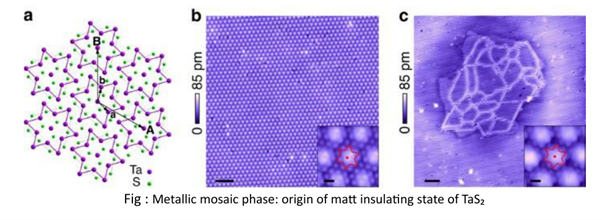
What is Hidden Metallic State?
The term sounds mysterious, and it is. In materials science, a ‘hidden’ state is one you can’t reach just by slowly heating or cooling the material. It’s like a secret room you can only enter if you know the exact knock on the door.
For TaS₂, the knock is a burst of light lasting only femtoseconds (a millionth of a billionth of a second). This jolt scrambles the electrons just enough to break them out of their stuck configuration, letting them move freely turning the material into a conductor.
Even stranger, this metallic state doesn’t vanish instantly. It can persist long after the laser pulse is gone, like a memory of being unlocked.
Why would this change computing?
A material like TaS₂ could revolutionize this as follows.
- Speed: Switching between insulating and metallic states could happen in terahertz frequencies: up to 1000 times faster than today’s gigahertz processors.
- Energy Efficiency: The switching can be done with tiny bursts of light instead of constantly applied voltage.
- Miniaturization: Being just a few atoms thick, these materials could pack an enormous number of switches into a small space.
Mechanism of Switch
TaS₂ is usually an insulator that can be turned metallic with a femtosecond laser pulse that frees trapped electrons. This ‘hidden metallic state’ lasts briefly but is repeatable without damage, enabling ultrafast, low-energy switching. Such quantum material behaviour could power terahertz-speed computers, far surpassing silicon’s limits.
Beyond TaS₂
Beyond TaS₂, 2D materials like graphene, MoS₂, and WTe₂ offer unique electronic properties. By stacking them into van der Waals heterostructures, scientists create custom ‘designer’ materials like quantum Lego blocks. TaS₂’s hidden metallic state is one striking example of this rapidly expanding quantum materials revolution.
Challenges
Challenges remain producing large, flawless TaS₂ sheets, controlling the hidden state across billions of transistors, and integrating it with current chip technology. Yet progress is rapid, and the potential for ultrafast, efficient computing keeps researchers pushing forward.
The Big Picture
The hidden metallic state in TaS₂ is more than a physics curiosity it’s a glimpse into the next era of computing. Just as the transistor replaced vacuum tubes, and integrated circuits replaced individual transistors, quantum materials may replace silicon as the foundation of our devices.